
Dr. Amir Guorgui completed his dental education at the University of Montreal in 2001. He holds a prestigious Mastership designation at the College of Sedation, a recognition of his unwavering dedication to delivering top-notch sedation services to his patients. As an esteemed member of the Vaughan community, Dr. Guorgui takes great pleasure in connecting with his patients and imparting valuable knowledge about their oral health.
Why Choose Invisalign Over Traditional Braces? A Full Comparison
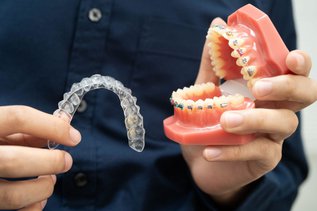
Invisalign vs braces is a choice between clear trays you remove to eat and braces that stay fixed to your teeth; the right one moves your bite the way it needs while you can live with it every day.
Aligners suit some crowding, spacing, and mild bite problems, and you wear the trays most of the day. Fixed braces still handle a wider range of problems because the wire stays on. Length depends on how much the teeth must move and how consistently you cooperate. The fee follows that same complexity, the kind of appliance, and how long treatment runs, not a single sticker price.
Both options require a retainer afterward, or your teeth can drift. A scan and an exam come before anyone can say which appliance fits. Mapleridge Smile Centre, at 10175 Keele St. Unit 4 in Maple, provides Invisalign for patients in Vaughan and Maple and will tell you if aligners are the wrong tool.
Key Takeaways
- Aligners are a series of clear plastic trays. Braces are brackets and a wire fixed to the teeth.
- Clear aligners correct some orthodontic problems, but not all. Traditional braces can correct almost any orthodontic problem.
- Aligners only work if you wear them about 20 to 22 hours a day. Braces keep working because you cannot take them off.
- You remove aligners to eat and to brush. Braces stay on, so hard and sticky foods can break a bracket, and you have to clean around the wire.
- Soreness for a day or two when teeth start moving is common with either appliance. That pressure is not a sign that something has failed.
- Treatment length is an estimate after an exam. A simple spacing problem finishes sooner than a bite that needs a lot of movement.
- Private insurance often treats orthodontics as its own benefit. Orthodontic services under the Canadian Dental Care Plan are not open yet.
Find our Dental Clinic Near You
What Invisalign vs braces changes in daily life
The two appliances push teeth with steady pressure, then part ways when you are not in the chair. Aligners are a stack of custom trays. You wear one set, then switch to the next. Braces are brackets glued to the outside of the teeth, with a wire that the dentist adjusts at visits. The Canadian Association of Orthodontists describes clear aligners as useful for some orthodontic problems, but not all , while traditional braces can correct almost any orthodontic problem.
That difference shows up at meals, at the sink, and in how often you need a chair. It also shows up in what you have to remember. Nobody should pick from a photo of a smile alone.
You learn how clear aligners work at the first visit: they are a medical appliance you manage yourself between visits. You switch to the next set on the schedule you were given, usually every one to two weeks, and you bring the trays you aren't wearing to check-ins so the dentist can see whether the teeth are tracking the plan. If a tooth isn't seated in the plastic, the next tray will not fix it by magic. The dentist may have you wear the current tray longer, or order a refinement, which is a short extra series after a new scan. Braces handle the same surprise at an adjustment visit, by bending the wire, rather than by manufacturing a new tray. Ask which of those paths your case is more likely to need. Refinements are common. They are not a sign the first plan failed.
| Daily point | Invisalign | Traditional braces |
|---|---|---|
| What you wear | A series of clear plastic trays | Brackets and a wire fixed to the teeth |
| On or off | Removed for meals, brushing, and anything but water | Fixed until the dentist removes them |
| Food | No special diet while the trays are out | Hard, sticky, and very chewy foods can break a bracket |
| Cleaning | Brush and floss the way you already do | Clean around brackets, wire, and elastics |
| Visits | Check-ins while you change trays at home | Adjustment visits to reshape the wire |
| Fit | Some alignment problems, not every bite | Almost any orthodontic problem |
| Your part | Wear the trays about 20 to 22 hours a day | Leave the braces alone and keep them clean |
A tray that spends the evening in a napkin is not moving teeth. A bracket that pops off is not moving that tooth either. The appliance that looks easier on day one can be the slower one if it does not match your habits.
Before you decide, ask for answers in plain language:
- Which teeth have to move, and which problem is a jaw issue rather than a tooth issue.
- Whether the plan needs small tooth-coloured attachments so the tray can grip.
- How many hours a day the trays must stay in, and what happens if you miss that.
- What you cannot eat with braces, and what a broken bracket does to the timeline.
- Whether a retainer is included, and how often you will wear it after the last tray.
Is Invisalign better than braces?
Invisalign is better than braces only when the movement you need is one aligners can make, and you will actually wear them. For a large bite problem, or for someone who will not keep trays in, braces are the more reliable tool because they do not depend on a daily decision.
"Better" in ads usually means less visible. Visibility matters, and it is a fair reason to ask about cosmetic dentistry in Vaughan . It is not the same thing as finishing in the right bite. A nearly invisible tray that cannot rotate a tooth, or that sits in a case all afternoon, does not beat a brace that does the job.
When aligners are a reasonable fit
Aligners are built for people who can keep a routine. Mild to moderate crowding, gaps, and some smaller bite issues are the usual starting point. You should have healthy gums, and you should be ready to take the trays out only to eat and to clean, then put them straight back in.
Teens can do well when a parent is willing to check that the trays are actually in, not in a pocket. Adults often do well because they chose the treatment and they mind how the trays look at work. Age alone doesn't decide it. Gum health, how your teeth sit, and whether you smoke or skip cleanings matter more than your birthday.
Attachments are part of many plans. They are small tooth-coloured bumps bonded to a few teeth, so the plastic has something to push against. They are not metal braces, but they are visible up close. If a plan needs them on most teeth, ask to see that on the screen before you agree. You should know what your smile will look like in month two, not only in the after photo.
When fixed braces still do the heavier work
Braces are still the right call when teeth need movement aligners struggle with, or when the bite is a jaw problem rather than a crooked tooth. Severe crowding, a large underbite, a crossbite that involves the jaw, and badly rotated teeth often need the control of a wire. The wire can be adjusted in more than one direction at a visit. A tray can only do what that plastic shape was built to do.
Braces also suit someone who will not remember a tray. A younger teen who loses things, or an adult who snacks all day and will not brush before every reinsert, often finishes sooner in something they cannot remove. That is not a punishment. It is how the appliance works.
"I look at the scan before I recommend trays. If the teeth need a movement aligners cannot make, I say that before we order a series. A clear tray will not finish a large bite change just because it is less visible. I would rather stop at the consult than have you wear trays for a year and still need a different plan," says Dr. James C.H. Ko, DDS, Mapleridge Smile Centre .
The benefits of braces over Invisalign
The benefits of braces over Invisalign are control, constant wear, and the range of problems a wire can treat. Those are real advantages. That's also why braces are still used when a clear tray would be more comfortable but less effective.
Braces do not ask you to be disciplined about hours. They ask you to be disciplined about food and cleaning. For some people, that trade is easier. You cannot leave braces on the lunch table. You also cannot eat a hard candy without risking a broken bracket, and you cannot floss in one quick pass.
What braces still do better:
- They can correct almost any orthodontic problem, including ones aligners are not built for.
- They work the full day without a wear-time target you have to hit.
- The dentist can change the force at adjustment visits instead of waiting for the next tray in a pre-made series.
- Ceramic or tooth-coloured brackets are an option when you want less metal and still need a fixed appliance. They are still visible up close.
- A younger patient who will not keep track of trays is less likely to stall.
What you give up is just as concrete. The brackets show in photos. Cheeks can get sore where a wire end sits, especially after an adjustment. Sticky and hard foods are off the menu until the braces come off. Cleaning takes longer, and plaque left around a bracket can mark the enamel.
If your main worry is being seen in braces at work or at school, say that at the consult. It is a legitimate constraint. It should sit beside the clinical one, not replace it.
How long does Invisalign take
How long Invisalign takes depends on how far the teeth must move and whether the trays stay in. A dentist can give a range after the scan. That range is an estimate. Teeth don't all respond on the same calendar, and a week of missed wear pushes the end date out.
No single number fits every mouth. A small gap is not the same job as a bite that needs many steps. Switching trays every one to two weeks is the usual rhythm, but the number of trays determines the length. Someone who wears them about 20 to 22 hours a day stays closer to the plan. Someone who wears them only at night should expect the plan to slip, or to need a new scan.
Braces have the same kind of estimate, not a shorter one by default. A simple case can be quicker in either appliance. A complex case takes longer in both. Claims that one method is always faster leave out the bite in front of the dentist.
Invisalign for teens
Invisalign for teens works when the teen will wear the trays at school, at practice, and overnight. The clinical question is still the bite. The practical question is whether the trays will survive a locker, a lunchroom, and a sports bag.
Parents should ask who checks wear, what happens if a tray is lost, and whether the plan allows for teeth that are still coming in. A compliance dot that fades with wear can help an adult see if the trays were actually used. It does not replace the conversation. If the likely outcome is a tray in a pocket for months, braces are the kinder plan, because treatment doesn't pause every time the routine slips.
Sports and music matter too. A mouthguard over braces is awkward. Taking aligners out for a game is easy, and then someone has to put them back in. Name that before you start, not after the first tournament.
Invisalign for adults
Invisalign for adults is common because many people do not want brackets in meetings, in photos, or in a client-facing job. The teeth can still move. Gum and bone health decide whether they should. Receding gums, active gum disease, or a tooth that is already loose must be addressed before any appliance starts pushing.
Adults also snack more often than they admit. Every coffee with milk, every sip of a soft drink, and every bite means the trays come out, and the teeth get brushed before the trays go back in. If that sounds unrealistic on a workday, say so. A fixed brace may annoy you more at first and slow you less by month four.
Old dental work changes the plan as well. A dental crown can take a bracket or an attachment. An implant cannot be moved. The tray has to work around anything that is fixed in the bone. That is a normal part of the exam, not a reason to guess from a quiz online.
Clear aligners vs braces for meals and cleaning
Clear aligners vs braces is mostly a difference in cleaning and eating once the clinical fit is settled. Aligners come out. Braces do not. That single fact drives the stains, broken brackets, and cavities people complain about later. You still book a teeth cleaning in Vaughan during treatment because tartar a toothbrush misses doesn't come off with the trays or the wire.
With aligners, the rule is simple and easy to break. Take them out to eat. Drink water with them in. Anything else waits until the trays are out and the teeth are clean. Food left under a tray sits against enamel for hours. That is how aligner treatment, which feels cleaner, still ends with decay.
A workable aligner routine looks like this:
- Take the trays out before you eat or drink anything other than plain water.
- Rinse the trays in cool water. Hot water can warp the plastic.
- Brush and floss your teeth before the trays go back in.
- If the trays look cloudy, brush them with a soft brush and clear, unscented soap. Skip toothpaste that can scratch them.
- Keep the case with you. Napkins are how trays get thrown away.
Braces ask for a different habit. You brush after meals because food packs around the brackets. Floss threaders or small brushes get under the wire. You cut hard food small, and you skip toffee, popcorn kernels, and ice. A loose bracket means a repair visit, and the tooth it was attached to stops moving until it is glued back on.
Neither routine is glamorous. The one you will still do in month eight is the one that belongs in the plan.
What Invisalign pain feels like
Invisalign pain is usually pressure, not a cut. A new tray feels tight for a day or two because it's doing its job. The same thing happens after a braces adjustment, when the wire is working. Soreness that fades is expected. Pain that keeps you from eating, or a tray edge that slices the cheek every day, is a reason to call rather than to wait for the next check-in.
"The tight feeling on a new tray is the tooth starting to move. What I want a patient to call about is an edge that cuts, or soreness that is still sharp after a couple of days. Pressure that fades is the tray working, but a cut that is still there on day three needs the plastic adjusted, not another week of waiting," says Dr. James C.H. Ko, DDS, Mapleridge Smile Centre .
Aligners are smooth, so they rarely poke the way a wire end does. They can still rub if the plastic edge is sharp, and the dentist can trim that. Braces are more likely to irritate the cheek right after a wire change. Wax helps until the cheek toughens or the wire is tucked in.
What people call pain is sometimes a broken routine. A tray worn only at night, then forced in after two days off, hurts more because the teeth have started to rebound. A bracket that has come loose and is swinging on the wire hurts because it is not doing its job. Neither problem is solved by hoping it will feel better next week.
Over-the-counter pain relief is enough for most people during those first tight days. Moving teeth is uncomfortable, and nobody should promise a sore-free week. If you have a low tolerance for sore teeth, ask how the first week usually feels for a case like yours, and plan soft meals for the day you switch trays or get an adjustment.
Speech can feel off for a few days with a new tray, usually a light lisp while your tongue learns the plastic. It fades for most people. A wire rarely changes speech unless something is loose and clicking. If the lisp is still there after the first week, the edge of the tray may need trimming. That is a short visit, not a reason to stop wearing the trays while you wait a month.
What changes the fee for aligners and braces
The fee is not one number for "Invisalign" and another for "braces." It moves with how complex the bite is, whether the appliance is fixed or removable, and how many months the estimate covers. A short plan with a few trays is not priced like a full sequence with refinements. A braces case that needs many adjustments is not priced like a small one.
Ask what the quote includes before you compare two offices. Refinement trays, a lost-tray policy, retainers, and repair visits are either in the fee or they are not. A low starting figure that leaves those out is not a lower fee. It is an incomplete one.
Private dental plans often list orthodontics apart from cleanings and fillings. Many pay a percentage up to a lifetime maximum, and some only pay for a dependent under a set age. Call the insurer with the treatment name, not with a guess from a forum. The office can give you a written estimate to send in. The insurer, not the advertisement, decides what they reimburse.
The Canadian Dental Care Plan is a separate question. The federal Dental Benefits Guide says you can request a specified range of limited orthodontic services at a date to be determined, and that preauthorization will be required. The criteria described there are narrow: children under 18 with a severe, functionally handicapping malocclusion, and adults with a craniofacial anomaly such as cleft lip and palate tied to that kind of malocclusion. That is not cosmetic straightening. Do not plan on the CDCP paying for aligners or braces while those services are still listed as unavailable.
If you are a CDCP patient for other care, the clinic follows the Ontario Dental Association fee guide, not a reduced CDCP fee. You are responsible for any co-payment and for the difference between the CDCP-approved amount and the ODA fee. Eligible claims are billed directly through Sun Life. A CDCP dentist in Vaughan can explain that balance before treatment. It does not turn an aligner fee into a covered cosmetic service.
Invisalign cost in Maple is priced after a scan, not from a national average. Financing may be available. The number that matters is the one on your estimate, with retainers and refinements named.
How the exam picks the appliance
The exam is what makes the choice specific. A photo of your smile isn't enough, and a quiz that asks only your age isn't enough. The dentist looks at your teeth, bite, gums, and how you actually live.
The first visit usually includes a look at oral hygiene, gum health, how the teeth are lined up, your age, whether you smoke, and whether the jaw has finished growing. Digital scans and X-rays replace the old putty mould for most aligner plans. You should leave knowing which teeth move, what the appliance will feel like, and what you have to do at home. If both options are clinically possible, visibility, meals, and your schedule can break the tie.
Bring the constraints you already know:
- Work or school settings where you do not want brackets in every photo.
- A sport, a wind instrument, or a job with constant coffee and snacks.
- A history of losing small things, or a teen who will need someone else to enforce wear.
- Gum disease, implants, crowns, or a tooth that already feels loose.
- A budget and an insurance maximum, so the estimate can be compared with the real benefit.
If aligners are a poor fit, that answer is useful. It saves you a year of trays that never would have finished the bite. If braces are a poor fit because you will not keep them clean or you cannot accept how they look, that answer is useful too. The failed plan is the one you chose to impress someone who doesn't have to wear it.
Write the home routine down before you leave. Which tray number you are on, the date you switch, where the case lives, and who to call if a tray cracks or a bracket lifts. People fall behind in ordinary weeks, not in dramatic ones: a trip, a flu, a week of late nights. The plan survives those weeks if you know the next step. It stalls if the trays sit on a bathroom shelf until the next appointment.
Pick the appliance you will still be wearing in month six
Invisalign and braces both move teeth by steady pressure. They do not both survive the same day. Aligners win on looks, on meals, and on brushing, and they lose the moment the trays are out for too long, or the bite needs more control than plastic can give. Braces win on range and not needing a wear-time target, and they lose on food, cleaning, and visibility.
Use the exam to separate those facts. Ask which problems in your mouth aligners cannot treat, how many hours the trays need, whether attachments will show, what breaks a bracket, and what the estimate includes after the last active tray. Then match that list to the week you actually have, not to the week you wish you had.
A retainer is part of either finish. Teeth that aren't held can shift, which is usually why a straight result doesn't last. Ask how the retainer works before you start, not after the last visit.
If you want that exam for aligners in Vaughan or Maple, book a consultation for Invisalign in Vaughan . Bring your questions about the bite, the hours, and the fee. You should hear a direct answer on whether trays are the right tool before any aligner is made.
Frequently Asked Questions
What is the difference between Invisalign and braces?
Invisalign uses a series of clear trays you remove to eat and brush. Braces are brackets and a wire that stay on the teeth until treatment ends. Both move teeth over time. They differ in what you can eat, how you clean, and which bites they can treat.
Is Invisalign or braces better?
Neither is better for every mouth. Aligners are a strong fit for some crowding and spacing, especially if you wear them most of the day. Braces are the stronger fit when the bite needs more control, or when you will not keep trays in.
How do metal braces vs Invisalign compare for a complex bite?
Metal braces can correct almost any orthodontic problem because the wire stays on and can be adjusted. Aligners are useful for some problems, not all. A large jaw discrepancy or severe crowding is a reason to ask whether trays can finish the case.
Does Invisalign work if I only wear the trays at night?
No. The trays need about 20 to 22 hours a day. Night-only wear lets teeth drift back between sessions, which adds time or forces a new scan. If you cannot wear them during the day, braces are the option that does not rely on that habit.
Can I eat with Invisalign aligners in?
Take them out for meals and for any drink that is not plain water. Eating with them in can crack a tray and trap food on the enamel. Brush before you put them back in so you don't seal sugar against your teeth.
Does the Canadian Dental Care Plan pay for Invisalign?
Not as a cosmetic service you can book today. Limited orthodontic services under the plan can be requested at a date still to be determined, with preauthorization, and only for narrow clinical criteria. Plan on a private estimate, and ask the insurer if a separate orthodontic benefit applies.
What should I do if I lose an aligner?
Call the office before you skip ahead to the next tray or go back to an old one on your own. Wearing the wrong tray can move teeth off the plan. Keep the case with you so a tray is less likely to go out with a napkin.
